


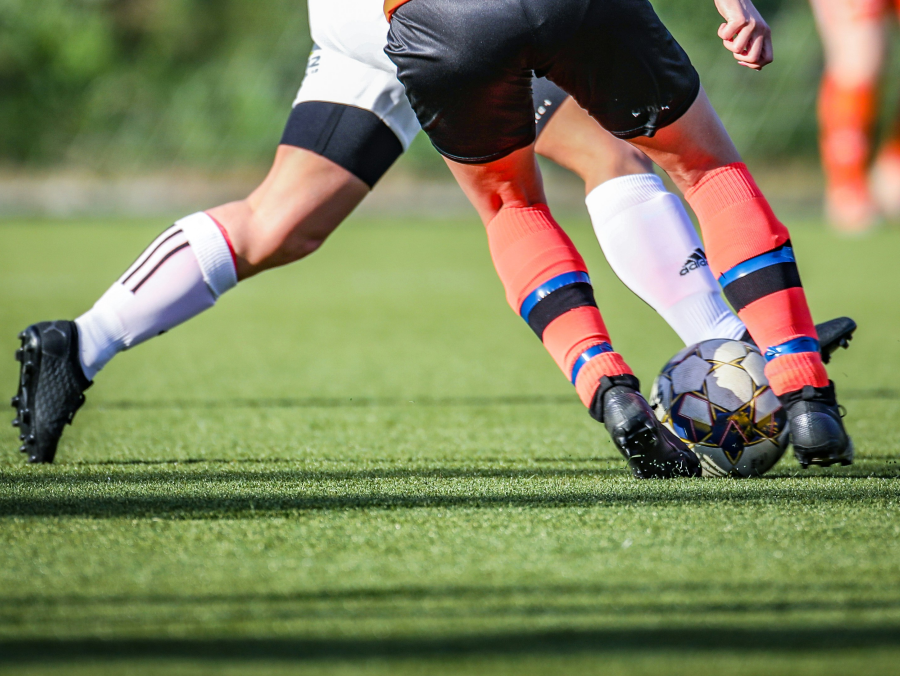
Ankle sprains are among the most common injuries in sport. Soccer, volleyball, basketball, athletics and many other disciplines report a high incidence of ankle sprains in both professional and recreational athletes.
Despite often being considered a relatively minor injury, an ankle sprain should never be underestimated. If not properly managed, it may lead to persistent symptoms, recurrent injuries and chronic ankle instability, all of which can significantly affect athletic performance and long-term participation in sport.
What Happens During an Ankle Sprain?
Most ankle sprains involve the lateral aspect of the ankle and occur during situations that are extremely common in sport: landing awkwardly after a jump, changing direction suddenly or stepping on an uneven surface or another player's foot. In these situations, the foot rapidly moves into inversion, meaning that the sole turns inward. This movement is often combined with plantarflexion, placing considerable stress on the lateral ligament complex. The anterior talofibular ligament (ATFL) is usually the first structure to be injured and is considered the most commonly damaged ligament in lateral ankle sprains. More severe injuries may also involve the calcaneofibular ligament (CFL) and, less frequently, the posterior talofibular ligament (PTFL).
Grading the Injury
Ankle sprains are generally classified into three grades of severity.
Grade I injuries
Involve mild stretching of the ligaments without significant structural damage. Pain and swelling are usually limited, and athletes are often still able to walk and occasionally even continue participating in activity.
Grade II injuries
Involve partial tearing of the ligament. Swelling and bruising become more apparent, weight-bearing may be painful and functional limitations are usually more significant.
Grade III injuries
Involve complete rupture of one or more ligaments. Swelling is often substantial, instability may be present and athletes are typically unable to continue sporting activity.
Importantly, the anatomical severity of the injury does not always determine recovery time. Individual responses, sport-specific demands and rehabilitation quality all influence the return-to-sport process.
Why Does the Ankle Keep Spraining?
One of the most frustrating aspects of ankle sprains is their high recurrence rate. Many athletes report multiple episodes involving the same ankle throughout their sporting careers. The problem extends beyond the injured ligament itself. Following an ankle sprain, athletes may experience deficits in mobility, strength and neuromuscular control, as well as an impaired ability to perceive joint position and movement. In other words, even when pain and swelling have resolved, the ankle may not yet be fully prepared to tolerate the unpredictable demands of sport. This is why successful rehabilitation cannot simply be based on symptom resolution.
Rehabilitation
Rehabilitation following an ankle sprain involves several objectives that often overlap and progressively build upon one another.
The first step is usually to restore joint mobility, particularly ankle dorsiflexion. Restrictions in dorsiflexion can alter running, jumping and landing mechanics and may increase the risk of future injury. At the same time, restoring muscular strength becomes essential. Particular attention is often given to the calf muscles and the peroneal muscles, which play a key role in controlling inversion movements and absorbing forces during sporting activities. However, one of the most important components of rehabilitation is the recovery of neuromuscular control and proprioception. Early stages may involve simple single-leg balance exercises. As the athlete progresses, rehabilitation can include unstable surfaces, externally induced perturbations and increasingly dynamic activities. The ultimate goal is not simply to improve balance but to restore confidence in the ankle and prepare it for the constantly changing demands of sport.
Return to Sport
Return to sport should never be determined solely by the amount of time that has passed since the injury. Before full participation is considered, athletes should be able to walk, run, jump and change direction without pain or feelings of instability. Likewise, the ankle should demonstrate the ability to tolerate progressively increasing sport-specific loads. The objective is not simply to return as quickly as possible but to return in the best possible condition while minimizing the risk of recurrence.
Prevention of Recurrence
Preventing future ankle sprains requires more than simply strengthening the ankle itself. A comprehensive strategy should include:
- progressive exposure to sporting demands
- lower-limb strength training
- balance and proprioceptive exercises
- adequate recovery
- continuous monitoring of symptoms and movement quality
Consistent neuromuscular training appears to be one of the most effective strategies for reducing recurrence rates and improving long-term ankle function.
Conclusions
An ankle sprain should not be regarded as a minor injury that simply resolves with time. Appropriate management requires attention to mobility, strength and neuromuscular control. A structured and progressive rehabilitation process can substantially reduce the risk of recurrent injuries and allow athletes to return safely and effectively to their sport.
References:
- Brukner P, Khan K. Brukner & Khan's Clinical Sports Medicine: Injuries. McGraw-Hill Education.
- Doherty C, Delahunt E, Caulfield B, et al. The incidence and prevalence of ankle sprain injury: a systematic review and meta-analysis of prospective epidemiological studies. Sports Medicine. 2014.
- Martin RL, Davenport TE, Fraser JJ, et al. Clinical Practice Guidelines: Lateral Ankle Ligament Sprains Revision 2021. Journal of Orthopaedic & Sports Physical Therapy. 2021.
- Gribble PA, Bleakley CM, Caulfield BM, et al. Evidence review for the 2016 International Ankle Consortium consensus statement on the prevalence, impact and long-term consequences of lateral ankle sprains. British Journal of Sports Medicine. 2016.
- Wikstrom EA, Brown CN. Minimum reporting standards for copers in chronic ankle instability research. Journal of Athletic Training. 2014.
How we manage it in Practice
The following example reflects an approach frequently adopted in our daily work with athletes. It is not intended as a universal rehabilitation protocol and should always be individualized according to the athlete, the sport and the severity of the injury.
In our experience, movement should be reintroduced as soon as symptoms allow. We usually begin with simple active mobility exercises and a gradual reintroduction of weight-bearing activities. As tolerance improves, strengthening exercises such as bilateral calf raises (3 sets of 15 repetitions) and single-leg balance exercises performed for approximately 30 seconds are introduced to restore muscular function and postural control. When the athlete demonstrates good load tolerance, rehabilitation progressively includes more dynamic activities such as step-ups, single-leg hops, running and eventually changes of direction and sport-specific movements.
Rather than following rigid timelines, we prefer to monitor movement quality and the ankle's response during and after training sessions. Our goal is not only to return the athlete to play but to ensure that they do so with confidence and with the lowest possible risk of recurrence.