Welcome to the PhysiotrainingPRO website

Select your language

  • 1 - Biceps Femoris

    Long Head (1a)

    Origin: Superior part of the Ischial Tuberosity (4)

    Short Head (1b)                                      

    Origin: Lateral Lips of the Linea Aspera of the femur (5)

    Insertion: Fibular Head and Lateral Tibial Condyle (6)   

    Actions: leg Flexion, hip Extension and leg Lateral Rotation with the knee slightly bent

    Helping Synergist Muscles:

    • together with Gluteus Maximus, Gluteus Medius, Semitendinosus (2), Semimembranosus (3), Adductor Magnus it acts to produce hip Extension
    • Semitendinosus, Semimembranosus, Gastrocnemius, Gracilis and Popliteus when it acts to produce the leg Flexion
    • together with Tensor Fasciae Latae it acts to produce the Lateral Rotation of the leg

    Notes: it is the only one muscle which produce the Lateral Rotation of the knee. Both heads long and short provide rotary stability by preventing forward dislocation of the tibia on the femur during flexion

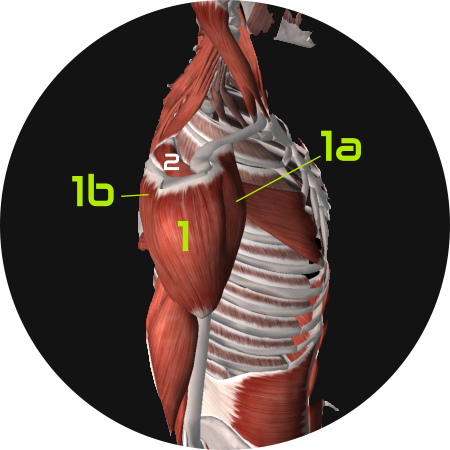
  • 1 - Deltoid

    Deltoid is constructed with three main sets of fibers: 

    Lateral/Medial (1)

    Origin: Acromion Process (12)

    Anterior (1a)

    Origin:lateral third and anterior Surface of the Clavicle (11)
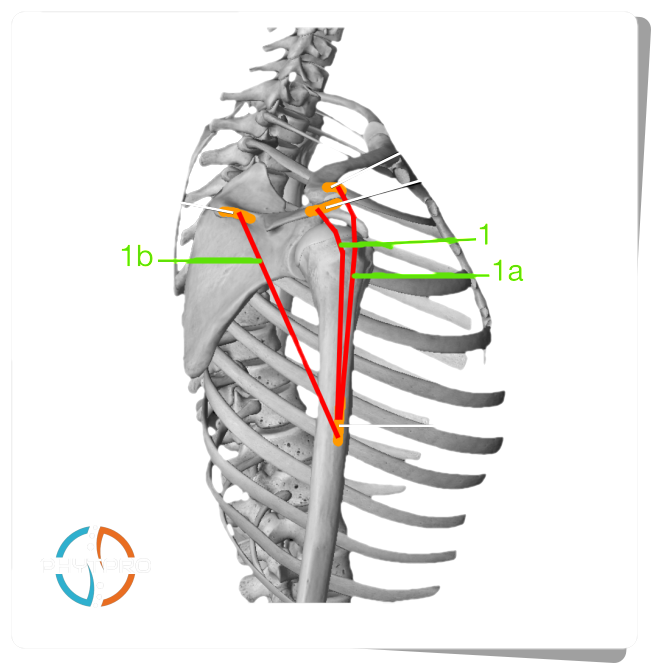
    Posterior (1b)

    Origin: posterior border of the Scapula Spine (10)

    Insertion: all fibers from three parts converge to insert to the Deltoid Tuberosity (13) on the Humerus

    Actions: arm Abduction (all fibers), shoulder Flexion and Medial Rotation of the arm (anterior fibers), shoulder Extension and Lateral Rotation of the arm (posterior fibers)

    Helping Synergist Muscles:

    • together with Long Head of the Biceps Brachialis and Supraspinatus (2) acts to produce arm Abduction
    • with Latissimus Dorsi, Teres Major (5), Long Head of the Triceps Brachii and Subscapularis acts to produce shoulder Extension
    • together with Short Head of the Biceps Brachii, Pectoralis Major, Supraspinatus (2) and Infraspinatus acts to produce shoulder Flexion

    Note:the Anterior part (1a) together with the Medial part (1), contribute to Anteversion. The Posterior part (1b)together with the Medial part (1), contribute to Retroversion

  • 1 - Rectus Femoris

    Origin: anterior inferior Iliac Spine (6)

    Insertion: together with Vastus Medialis (2), Vastus Intermedius (4) and Vastus Lateralis (3) joins the Quadriceps Tendon (8) to insert at the Patella (7) and Tibial Tuberosity (9)

    Actions: leg Extension and hip Flexion

    Helping Synergist Muscles:

    • together with Tensor Fasciae Latae, Sartorius (5), Adductor Longus, Adductor Brevis, Gluteus Minimus and Ileopsoas acts to produce the thigh Flexion
    • together with Tensor Fasciae Latae, Vastus Intermedius, Vastus Lateralis and Vastus Medialis acts to produce the leg Extension
  • 1 - Triceps Brachii

    Long Head (1b)

    Origin: Infraglenoid Tubercle of the Scapula (3)

    Lateral Head (1a)

    Origin:posterior and lateral Surface of the humerus (4)

    Medial Head (1c)

    Origin: posterior Surface of the humerus, below the Radial Groove (5)

    Insertion: Olecranon Process of the Ulna (6)

    Actions: forearm Extension, arm Adduction and Extension (shoulder Extension)

    Helping Synergist Muscles:

    Notes:the Medial Head (1c) can usually be visible closer to the elbow joint as it is mostly covered by the Long (1b) and Lateral (1a) Head

  • 2 - Anconeus

    Origin: lateral Epicondyle of the humerus (7)

    Insertion: posterior Surface of the Ulna (8)

    Actions: forearm extension

    Helping Synergist Muscles:


  • 2 - Semitendinosus

    Origin: Ischial Tuberosity (4)

    Insertion:upper part of the Medial Surface of the Tibia (7)

    Actions: Extension and Adduction of the thigh, Flexion and Medial Rotation of the leg (if knee bent)

    Helping Synergist Muscles:

    • together with Biceps Femoris (1), Semimembranosus (3), Gracilis, Sartorius, Gastrocnemius and Popliteus acts to produce Leg Flexion
    • together with Gluteus Maximus, Gluteus Medius, Semimembranosus, Biceps Femoris, Adductor Magnus (slightly) acts to produce Hip Extension
    • together with Semimembranosus, Gracilis, Sartorius and Popliteus acts to produce the Medial Rotation of the leg

    Notes: together with the Sartorius and Gracilis Tendons, it joins in the Pes Anserinus before tibia insertion

  • 2 - Supraspinatus

    Origin: Supraspinatus Fossa of the Scapula (14)

    Insertion: superior Facet of the Greater Tuberosity of the Humerus (7)

    Actions: Abduction and Lateral Rotation of the arm, shoulder joint Stabilization keeping the head of the Humerus pressed against the Glenoid Fossa of the Scapula

    Helping Synergist Muscles:

    Notes: together with Infraspinatus, Subscapularis and Teres Minor joins to form the "Rotator Cuff Muscles"

  • 2 - Vastus Medialis

    Origin: medial lip of the Linea Aspera (10)

    Insertion:together with Vastus Lateralis (3), Vastus Intermedius and Rectus Femoris joins the Quadriceps Tendon (8) to insert at the Patella (7) and Tibial Tuberosity (9) 

    Actions: leg Extension and Patella Stabilization

    Helping Synergist Muscles:

    • Vastus Lateralis, Vastus Intermedius, Rectus Femoris and Tensor Fasciae Latae
  • 3 - Infraspinatus

    Origin: Infraspinatus Fossa (16) and Spine of the Scapula (10)

    Insertion: medial Facet of the Greater Tubercle of the Humerus (7)

    Actions: Lateral Rotation of the arm, assists the shoulder Extension and stabilizes Humeral head in the Glenoid Cavity

    Helping Synergist Muscles:

    Notes: the Infraspinatus is a thick triangular muscle that joins to form the "Rotator Cuff Muscles" together with Supraspinatus, Subscapularis and Teres Minor 


  • 3 - Semimembranosus

    Origin: Ischial Tuberosity (4)

    Insertion:at the distal end of the muscle arise two tendons, one attaches to the Medial Condyle of the Tibia (7), the second passes upwards and laterally to form the Oblique Popliteal Ligament (8)

    Actions: Extension and Adduction of the thigh, Flexion and Medial Rotation of the leg  (if knee bent)

    Helping Synergist Muscles:

    • together with Biceps Femoris (1), Semitendinosus (2), Gracilis, Sartorius, Gastrocnemius and Popliteus acts to produce Leg Flexion
    • together with Semitendinosus, Gracilis, Sartorius and Popliteus acts to help the Medial Rotation of the leg
    • together with Gluteus Maximus, Gluteus Medius, Semitendinosus, Biceps Femoris and Adductor Magnus (superior fibers) helps the Hip Extension

    Notes: it is located deep to Semitendinosus

  • 3 - Vastus Lateralis

    Origin:Greater Trochanter, Intertrochanteric Line and lateral Linea Aspera of the femur (10)

    Insertion:together with Vastus Medialis (2), Vastus Intermedius (4) and Rectus Femoris (1) joins the Quadriceps Tendon (8) to insert at the Patella (7) and Tibial Tuberosity (9) 

    Actions: leg Extension

    Helping Synergist Muscles:

    • Vastus Medialis, Vastus Intermedius, Rectus Femoris and Tensor Fasciae Latae
  • 4 - Vastus Intermedius

    Origin: femur anterior and lateral surface (11)

    Insertion:together with Vastus Lateralis (3), Vastus Medialis (2) and Rectus Femoris joins the Quadriceps Tendon (8) to insert at the Patella (7) and Tibial Tuberosity (9) 

    Actions: leg Extension

    Helping Synergist Muscles:

    • Vastus Lateralis, Vastus Medialis, Rectus Femoris and Tensor Fasciae Latae
  • 5 - Teres Major

    Origin: lower part of the lateral border of the Scapula (15)

    Insertion: medial Lip of Intertubercular Sulcus of the Humerus (8)

    Actions: Medial Rotation and Adduction of the Humerus

    Helping Synergist Muscles:

    Notes: Teres Major muscle is active during the arm Extension from the flexed position

  • 6 - Subscapularis

    Origin: Subscapularis Fossa (9)

    Insertion: Lesser Tuberosity of the Humerus (8)

    Actions: Medial Rotation and Adduction of the Humerus (arm)

    Helping Synergist Muscles:

    • together with Pectoralis Major, Latissimus Dorsi, Teres Major, Deltoid (1) (anterior fibers) acts to produce the Medial Rotation
    • together with Pectoralis Major, Latissimus Dorsi, Teres Major, Teres Minor, Infraspinatus acts to produce arm Adduction

    Notes:together with Supraspinatus, Infraspinatus and Teres Minor joins to form the "Rotator Cuff Muscles

  • Sprinter during acceleration highlighting lower limb musculature and muscle fiber function in athletic performance.

    Anatomy Notes: Muscle Fibers

    Why are some athletes naturally suited for endurance events while others excel in sprinting or explosive movements? How much depends on genetics, and how much can be influenced by training? The answer lies largely in muscle fibers, the specialized cells responsible for producing force and movement.

  • Anatomical structure of skeletal muscle and organization of muscle fibers

    Muscles: Anatomy, Structure and Function

    The muscular system is one of the most fascinating and complex structures of the human body. Every movement we perform, from picking up an object to running, jumping, or simply maintaining an upright posture, depends on the coordinated activity of our muscles.

  • Athlete performing foam rolling for muscle recovery and mobility improvement

    Myofascial Release and Foam Rolling: Benefits, Limitations and Practical Applications

    Over the last two decades, the Foam Roller has become one of the most widely used tools among athletes, strength and conditioning coaches, physiotherapists and fitness enthusiasts.Today it is commonly found in gyms, rehabilitation clinics and athletic training facilities, where it is frequently used as part of warm-up, recovery and mobility routines.

We are updating our website. Work in progress!